The Phrase That Changes at the Last Note
Phrase endings can settle, suspend, or lead onward. Learn to hear how a performer shapes the final note, its release, and the silence that follows.
The common mistake with phrase endings is to hear the last note as a full stop. That can make a deliberate handoff sound like a finish, or turn a true arrival into a note that simply trails away. At a live concert, the distinction often lies in what the performer does after the pitch itself has been played.
Listen for three connected events: how the final sound is shaped, how it is released, and what the players do in the silence or transition that follows. These details reveal whether the music has reached a resting point, left a thought suspended, or passed its energy to what comes next.
How do you hear phrase endings at a concert?
A phrase ending is the point where a musical thought pauses, settles, or turns toward another idea. It is not always marked by a long note or a break. The ending may be subtle: a singer closes a vowel, a violinist changes bow direction, or a pianist lifts a hand while the instrument’s resonance continues.
In a concert hall, sound can linger after the performer stops actively making it. A piano string continues to resonate; a room adds its own reverberation. Distinguish that acoustic tail from the performer’s choice by watching for the motion that ends the sound and listening for whether the music’s next event feels connected or separate.
What makes an ending feel complete or open?
A complete ending gives the musical thought a sense of arrival. The final sound may taper, stop cleanly, or be followed by a clear space. An open ending keeps some expectation alive: the tone may remain active, the next entrance may arrive quickly, or the harmony may seem to lean toward another phrase.
Neither effect is inherently better. A distinct release can clarify a boundary before a contrasting section. A connected release can make a new phrase feel like a response rather than a fresh start. The useful question is what relationship the ending creates between the sound before it and the sound after it.
Why does the release matter more than silence alone?
Release is the way a performer stops sustaining a sound. For a singer or wind player, it involves the end of breath and tone. For a string player, it may be heard in the bow’s final motion. A pianist’s hand may leave the keys while the instrument continues to ring.
Silence by itself does not tell you whether a phrase is finished. A pause can feel restful after a clear release, or charged with expectation after a tone that seems to reach forward. Watch and listen for the transition: does the performer complete a gesture, hold its energy, or hand it to another player?
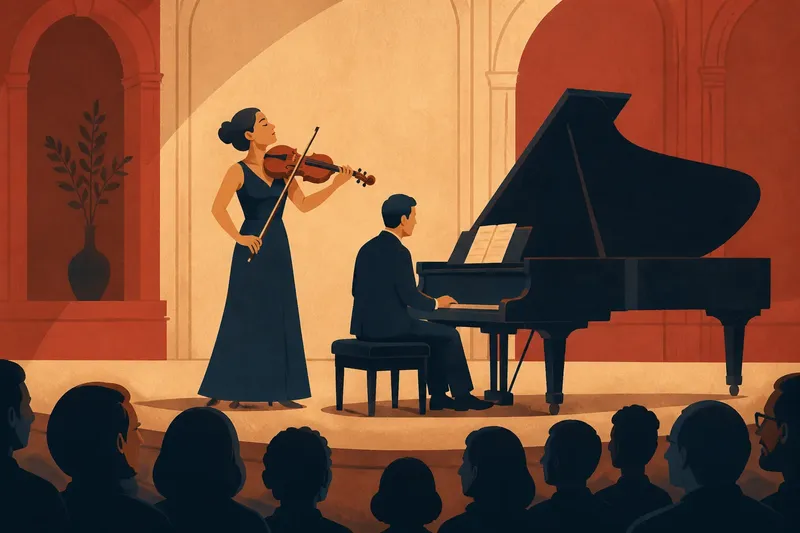
Imagine a violin and piano duet. The violin sustains its final tone, then lowers the bow as the pianist waits before beginning a new figure. That sequence may make the melody feel complete before the piano starts a separate thought. If, instead, the violin keeps the tone active and the piano enters while it still resonates, the overlap may make the second idea feel like a continuation. The concrete difference is the timing and character of the handoff, not simply the length of the pause.
What should you listen for at a phrase ending?
Choose one ending during a performance and follow what happens around it. Each observation can guide a different interpretation:
- Notice the final sound’s shape. If it tapers, hear whether the phrase seems to settle; if it stays full, consider whether it points onward.
- Watch the performer’s ending gesture. If the hand, bow, or breath completes a clear motion, hear whether that marks a boundary; if the gesture remains active, listen for continuation.
- Listen for the next entrance. If it begins after a distinct space, treat it as a possible new thought; if it overlaps or follows closely, hear whether it answers or extends the previous phrase.
- Separate room resonance from active playing. If the performer has stopped but the sound lingers, count that as the hall’s acoustic tail; if the performer continues shaping the tone, hear it as an ongoing musical gesture.
- Compare the ending with the phrase before it. If the final sound changes noticeably in character, consider whether the performer is emphasizing arrival; if its character stays connected, listen for a deliberate carry-through.
- Notice who takes up the sound next. If another player enters with a contrasting gesture, hear a possible change of direction; if the same musical character passes between players, listen for a shared phrase.
These are listening clues, not fixed rules. A soft note may still close a thought, and an overlap does not always mean that one phrase continues into another. Let the next musical event confirm or complicate your first impression.
Can a phrase ending be heard without reading music?
Does the last note have to be the loudest?
No. Volume is only one part of emphasis. A quiet sound can feel final through its release and the space that follows, while a loud sound can still seem to demand an answer.
Why can a pause feel unfinished?
A pause can preserve expectation rather than create rest. If the preceding sound remains active or another player appears ready to enter, the silence may feel like a held breath.
How can you tell whether room echo is part of the phrase?
Watch the performer as well as listening to the sound. If the player has finished the gesture and the tone only lingers in the hall, you are hearing resonance; if the performer continues shaping the sound, the phrase is still being actively voiced.
What if you cannot decide whether the phrase is finished?
Wait for the next entrance before settling on an interpretation. A new sound may confirm a boundary, or it may reveal that the apparent ending was a transition into another player’s part.
How does the next entrance change the ending?
The first sound after a phrase can clarify what the ending has done. A new melody after a clear release may sound like a change of subject. A quiet response from another instrument may make the first phrase seem to have asked a question. If the next sound arrives before the previous one has fully faded, the performers may be linking the ideas across the boundary.
Say you are seated near the back of a hall and hear a singer finish a line while the piano continues a soft figure. The singer closes the final vowel and lowers their head, but the pianist keeps playing. You can hear the vocal phrase as complete while the piano carries the music forward. The result is a clear vocal ending without a full stop in the larger passage.
What does a phrase ending reveal about interpretation?
Interpretation is how performers shape written music through choices about timing, tone, emphasis, and connection. At an ending, those choices determine whether a note feels like arrival, suspension, or transition. The score may set the musical material, but the live performance makes the relationship between its parts audible.
For your next concert, choose one phrase and listen beyond its final pitch. Watch for the release, notice who or what carries the sound onward, and let the next entrance revise your first impression if needed. That small change in attention helps you hear an ending not as a mark on the page, but as a decision about where the music can go.