Duo or Quartet for Your First Chamber Concert?
Duo or quartet for your first chamber concert? Compare musical conversation, texture, and attention to choose the listening experience that suits you.
The common mistake when choosing a first chamber concert is to assume that a quartet is simply a duo with more instruments. That can leave you listening for a single melody while missing the pleasure each format offers: a duo makes exchanges unusually exposed, while a quartet lets several musical roles overlap. If you are choosing between a duo or quartet for your first chamber concert, start with the kind of conversation you want to follow.
What changes when two musicians share the music?
In a duo, the musical relationship is hard to overlook. One player may introduce a tune while the other answers, supports it, or quietly changes its direction. With only two parts, a brief pause, a shift in bowing, or a change in breathing can reshape the exchange. The result can feel close and direct, like listening to two people finish and complicate each other’s sentences.
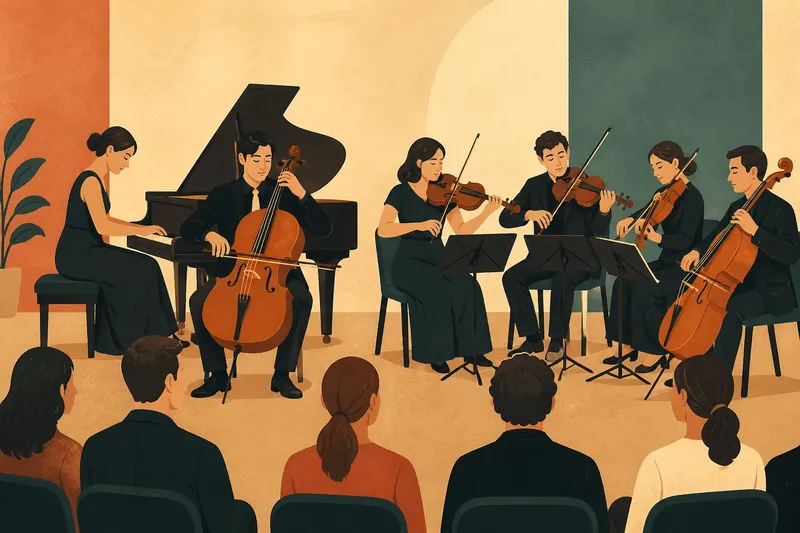
The pairing also affects what you hear. A violin and piano duo can move between a bright, sustained line and a keyboard’s broad range of notes. In a cello and piano duo, the cello’s lower register may make the conversation feel grounded, though either instrument can take the lead. A clarinet and piano pairing offers another contrast: the clarinet’s sustained tone can hover over the piano’s crisp attacks, then trade places in the listener’s attention.
That clarity is inviting, but it asks you to stay with the exchange. When one player has the melody, the other is not necessarily just accompanying. A chord change, a repeated figure, or a little rhythmic push from the second instrument may signal what the melody means. If you enjoy noticing how a reply alters a statement, a duo gives you room to listen closely without tracking many simultaneous lines.
What does a quartet add to the conversation?
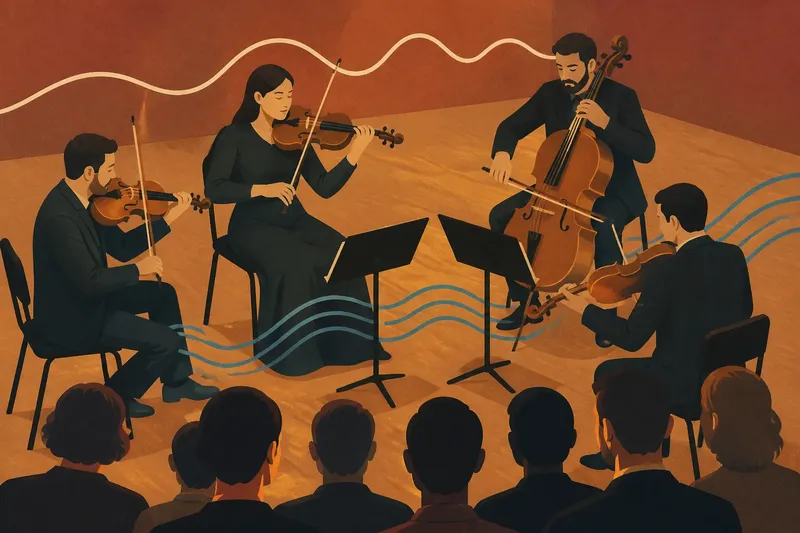
A string quartet usually brings two violins, a viola, and a cello into the same musical space. The arrangement creates more than four separate sounds. A line can pass from one violin to the other, settle into the viola, and gain weight from the cello. At other moments, the instruments may move together, split into supporting figures, or form small pairs within the larger group.
That shifting combination makes a quartet feel less like a two-person exchange and more like a conversation among people who can interrupt, reinforce, or quietly agree. You might hear the first violin carry a tune while the viola keeps a steady pattern. Then the cello may take over the tune, making the earlier violin line sound newly important as a response. The pleasure lies partly in recognizing who has changed the group’s direction.
There is more to follow, but not necessarily more noise. A quartet can play softly and still sound richly layered. Its parts may weave around one another, so the most interesting line is not always the one with the highest pitch. This makes the format rewarding if you like discovering relationships across the whole group. It can be less immediately transparent if you would rather follow one clear exchange at a time.
Which listening experience fits your attention?
Choose by the sort of attention you want to bring, not by a presumed difficulty ranking. Both formats can be welcoming, intricate, lively, or reflective. The instruments and the music on the programme matter as much as the number of players.
- Choose a duo if you want to hear a musical idea pass plainly between two contrasting voices.
- Choose a duo if you enjoy fine details, such as a shared breath, a held note, or a change in how one player supports the other.
- Choose a quartet if you want to follow several roles and notice how a melody changes hands.
- Choose a quartet if layered textures appeal to you, including moments when instruments cooperate without playing the same material.
- Let the instruments decide if you already have a favorite sound. A violin and piano duo offers a different color from a clarinet and piano pairing, while a string quartet blends four related instruments with distinct ranges.
Imagine you can attend one short recital and you usually enjoy hearing a singer accompanied at the piano. A cello and piano duo may be a comfortable first choice: you can listen for the cello’s line and notice how the keyboard supports or challenges it. If, instead, you often enjoy tracing different parts in an ensemble, a string quartet may be the more satisfying invitation. Neither choice predicts whether you will like every piece; it points toward the kind of interaction you are most curious to hear.
How can you follow the music without studying it first?
You do not need to recognize a composer, read notation, or know formal music terms to follow chamber music. Give yourself one simple listening task, then let it change as the piece develops. In a duo, listen for who begins an idea and whether the other player echoes, extends, or resists it. In a quartet, choose one instrument to follow for a while, then notice when another takes over its role.
For instance, you might follow the cello through a quartet movement. It could begin with a quiet pulse beneath the violins, then bring out a tune later. You can listen for what the other instruments do when that shift happens: do they fall back, answer, or keep a pattern moving? This gives your attention something concrete to hold without requiring you to understand the piece’s design in advance.
If you lose track, return to an audible feature: the lowest line, the shortest repeated figure, or the instrument that has just changed its rhythm. A printed programme can tell you the instruments and the order of pieces. Let it orient you, rather than turning listening into a search for the “right” interpretation. Your own attention can move freely between a melody, a texture, and the musicians’ exchanges.
What should you look for in a first concert?
Check the ensemble listed for the event, not only the concert’s broad label. “Chamber music” describes music for a small group, but a programme might include a duo, a quartet, or several different combinations. Look for familiar instruments if their sound draws you in, and read any brief programme note for clues about whether the pieces feature close dialogue, contrasting sections, or changing musical roles.
Also consider the setting. In a smaller room, you may see players’ gestures and notice how they coordinate entries. In a larger hall, the sound can feel more spacious, and the performers may be easier to hear from some seats than others. If seating is assigned, choose a place that suits your comfort and view; you do not need a special seat to understand the exchange.
For a first visit, a programme with one clear ensemble can make it easier to settle into its sound. A mixed programme can be appealing if you want to compare pairings or hear different textures in one sitting. If the listing is unclear, ask the venue what instruments will perform. Where an event’s format depends on the venue’s description, use that listing or contact the presenter rather than guessing from the concert title.
Which format should you choose?
Pick a duo if the idea of following a close, exposed exchange feels appealing. Pick a quartet if you would rather hear a small group distribute musical ideas among several voices. If both sound inviting, choose the concert with instruments you most want to hear or a programme description that sparks a specific question. That question might be as simple as “How does the melody change when another instrument takes it?”
A duo or quartet for your first chamber concert is not a test of musical knowledge. It is a choice about where to place your attention: on two players shaping a direct exchange, or on a group whose relationships keep shifting. Once you know which kind of conversation you want to hear, the best first concert is the one that makes you curious to listen.