A First Concert with One Question in Mind
A first concert with one question in mind helps you carry a curiosity through the performance and leave with a precise observation you can remember.
The most common mistake at a first concert is trying to catch everything at once. A first concert with one question in mind gives your attention a smaller task: carry one curiosity through the performance and notice how your thinking changes. The cost of scanning for every detail is that a vivid moment can pass before you have time to absorb it.
Your question does not need a final answer. It can work like a thread that you hold loosely, revising it when the music gives you a reason. The method is less about tracking who leads than about keeping one curiosity alive: What did I expect, what did I notice, and what changed my mind?
How do you choose a question for a first concert?
Imagine Maya is attending a chamber concert at a neighborhood arts center. She does not know the pieces, so she chooses a question that needs no background knowledge: “What makes a musical idea feel different when it returns?” It invites her to listen for change without predicting what that change should be.
A useful question is about something you can hear, leaves room for surprise, and can be remembered in a few words. “Will I like this?” can turn into a running judgment. “What changed between the first time I heard that sound and the next?” gives attention a specific task without requiring a verdict.
Keep the wording short. If you need a program note or a specialist term to remember it, simplify it. “What changes when the idea comes back?” is easier to carry than a question about a particular compositional technique.
How can you carry the question without scripting the music?
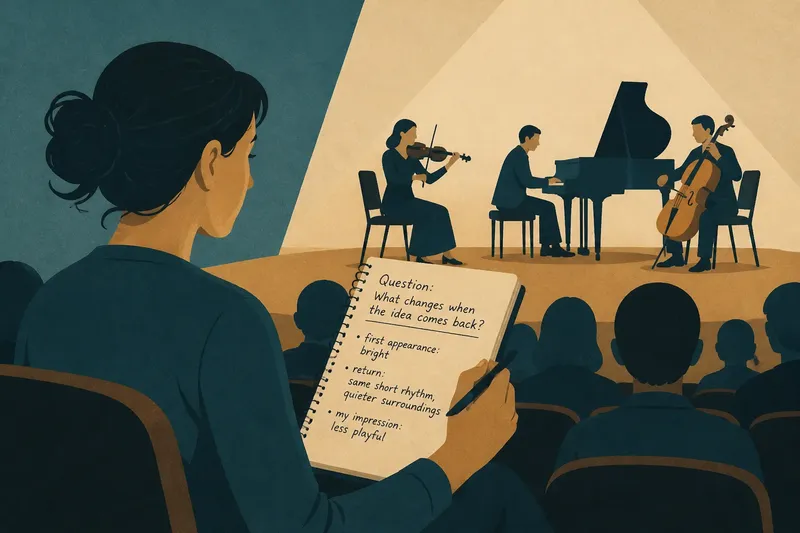
Maya checks the venue’s website for the concert length and seating information, then glances at the program titles. She writes her question at the top of a notebook page and leaves space below it. She does not write down an expected answer, such as “the second time will be louder,” because that could make her overlook a different kind of change.
During the performance, she listens first and writes only during a break or after a piece. A few plain words are enough: “same rhythm, softer ending” or “return felt unsettled.” The notes are reminders, not an attempt to capture every detail or explain the composer’s intentions.
How do you revise the question when a moment surprises you?
At the opening of the first piece, Maya hears a short, bright figure. When it returns later, the rhythm is recognizable, but the surrounding music makes it feel less playful and more hesitant. She had expected to compare changes in sound; now she wonders how what comes before a return affects the way she hears it.
She revises the question slightly: “What changes in my impression when an idea returns in a different setting?” That wording keeps her original curiosity while making room for context. She does not need to decide whether the music itself has changed more than her response has.
Say Maya’s notebook contains these invented starting notes: “first appearance: bright”; “return: same short rhythm, quieter surroundings”; “my impression: less playful.” Her next action is to listen for what surrounds the next return, rather than hunt for a specific instrument or gesture. If the later passage changes her impression again, she can add one phrase; if no clear return occurs, she leaves the question unanswered rather than forcing a pattern.
What should you do when the question stops helping?
Sometimes the music moves away from the feature you are following. Maya might notice a long, sustained passage that does not bring back the short figure. She can let her attention rest on that passage without inventing a connection. The question is a guide, not a rule for what she must hear.
If you lose the thread, return to the last moment you remember and describe it in everyday language. Was a sound repeated, shortened, interrupted, or placed beside something new? If nothing comes to mind, simply listen until something does. A question can remain open for part of a concert and still have been useful.
What do listeners ask about bringing a question to a concert?
Should I read about the music beforehand?
A short program note can supply names and context, but it is optional. Read enough to recognize what is on the program, then leave room for your own impressions.
What if I cannot name what I hear?
Use ordinary descriptions such as “high and steady” or “the same tune, but less playful.” The purpose is to remember your observation, not to prove that you know technical vocabulary.
Can I change my question during the concert?
Yes, when a moment shows that your wording is too narrow or assumes something you have not heard. Make a small revision that preserves the original curiosity, rather than replacing it every time your attention shifts.
Should I take notes while the musicians play?
Only if writing does not distract you or others. You can keep a short phrase in mind and write it down during an interval or after the performance.
What can you take away after the last note?
After the concert, Maya reads her notes in order. The first return seemed bright; the next felt hesitant because of its setting. She cannot claim that this explains the whole piece, but she can name how one remembered idea changed her listening.
For a first concert with one question in mind, keep the question open and let each observation revise it. Near the end, write down the moment that most changed your impression. That specific memory can guide your attention at the next concert, even if you arrive with a different question.